The tech job apocalypse
A deep dive on the numbers behind the tech job market

If you are a software engineer and have not been living under a rock, you would have heard that the tech job market is what people call “in shambles”.
My target this week was to figure out:
If this tech job apocalypse is true
If this is happening only for new graduates or for every level of seniority
What are the reasons behind this apocalypse.
Lets take a look at the layoff numbers first to figure out if the tech job market really is in shambles.
I should note that most of this data is for the US, but we can assume that since most big tech companies are US companies, the layoff/hiring effect ripples through to other markets (eg. Greece were I am based)
It is undeniable that since 2023 the layoffs (and not just the tech job market) have been brutal. One can take a look at the below graph from layoffs.fyi to understand what has transpired since COVID.
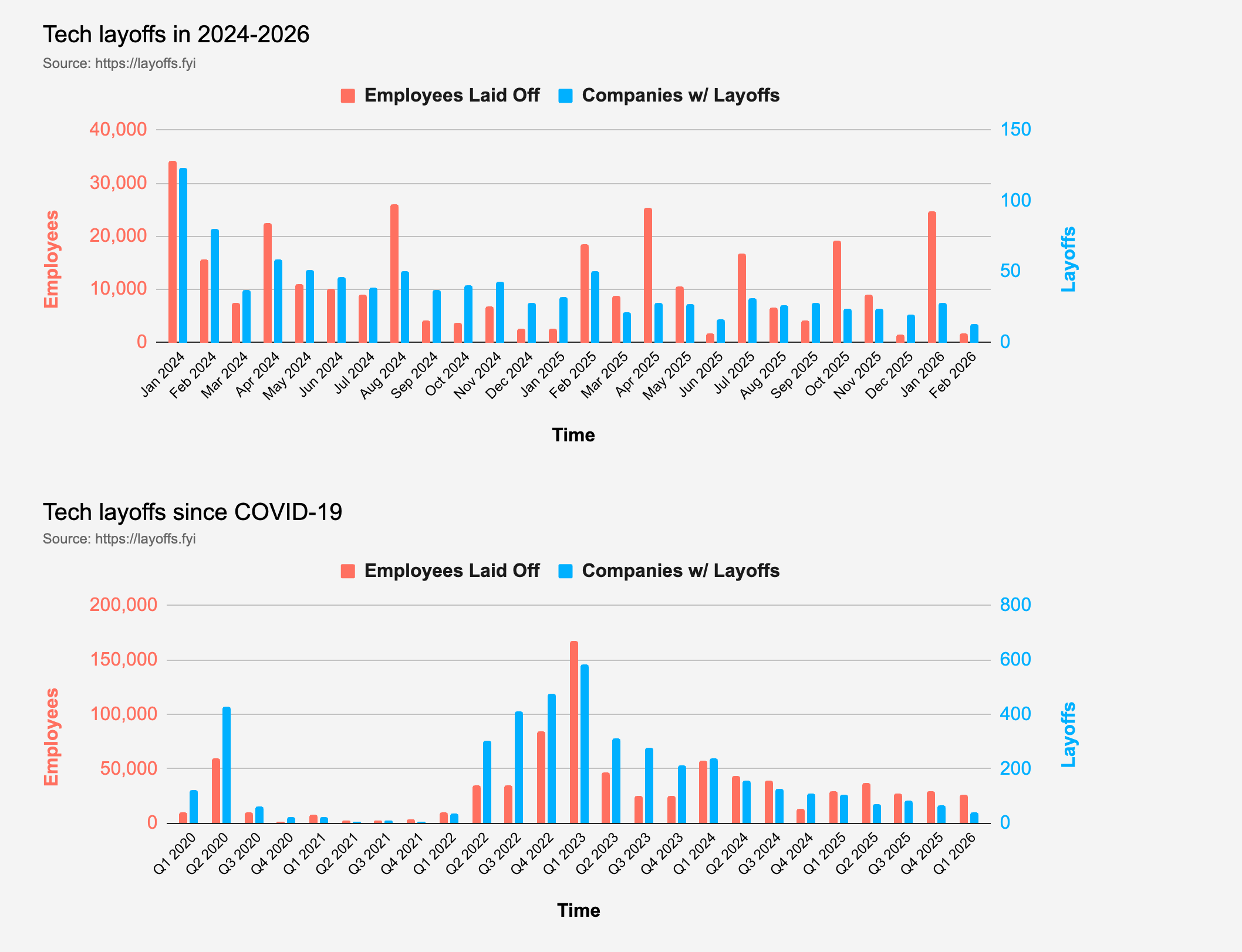
By taking a look at the charts we can see that a lot of layoffs took place in Q1 and Q2 of 2020, which can be attributed to COVID uncertainty. However, we can see that layoff numbers came back up in Q1 of 2022 and peaked in Q1 of 2023. That was the worst quarter with ~167.000 people laid off in tech, coming from about 586 companies. After Q1 of 2023, we can see a steady decrease till Q2 of 2024, but contrary to what someone might expect layoffs did not normalize but have stayed at about the same level since then (~30.000 layoffs per quarter).
However, one might argue that layoff numbers are high but hiring is also high. In this case we would have a net increase in tech jobs, even though the layoff numbers are high and therefore no tech apocalypse.
Lets take a look at the numbers regarding hiring
The most reliable tech job reports come from CompTIA with U.S. Bureau of Labor Statistics releases. See the graphs below.
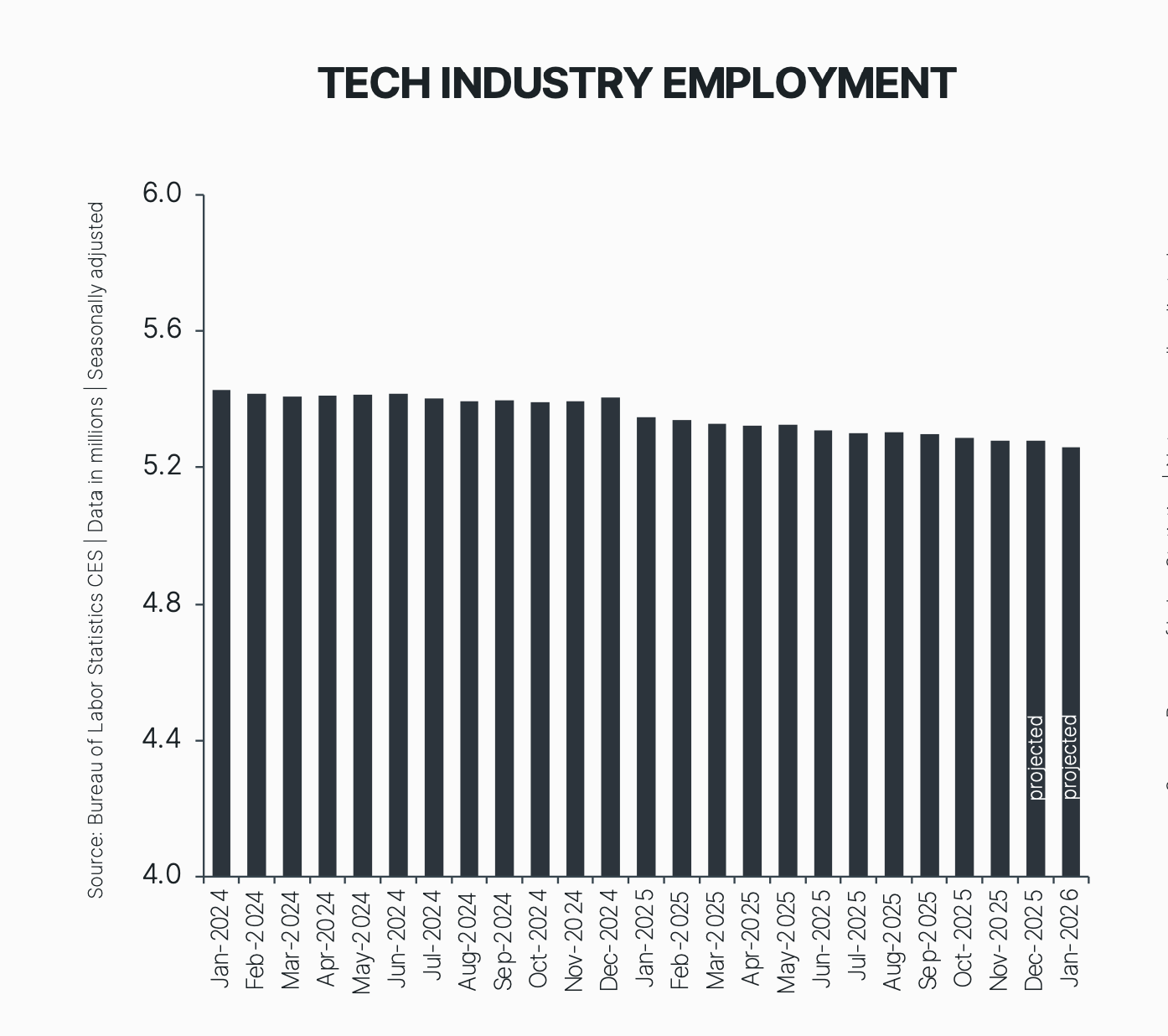
We can see that since January 2024 the tech industry employment has seen a downward trend. To be fair the rate of decrease is not as drastic as one would expect from the layoff numbers.
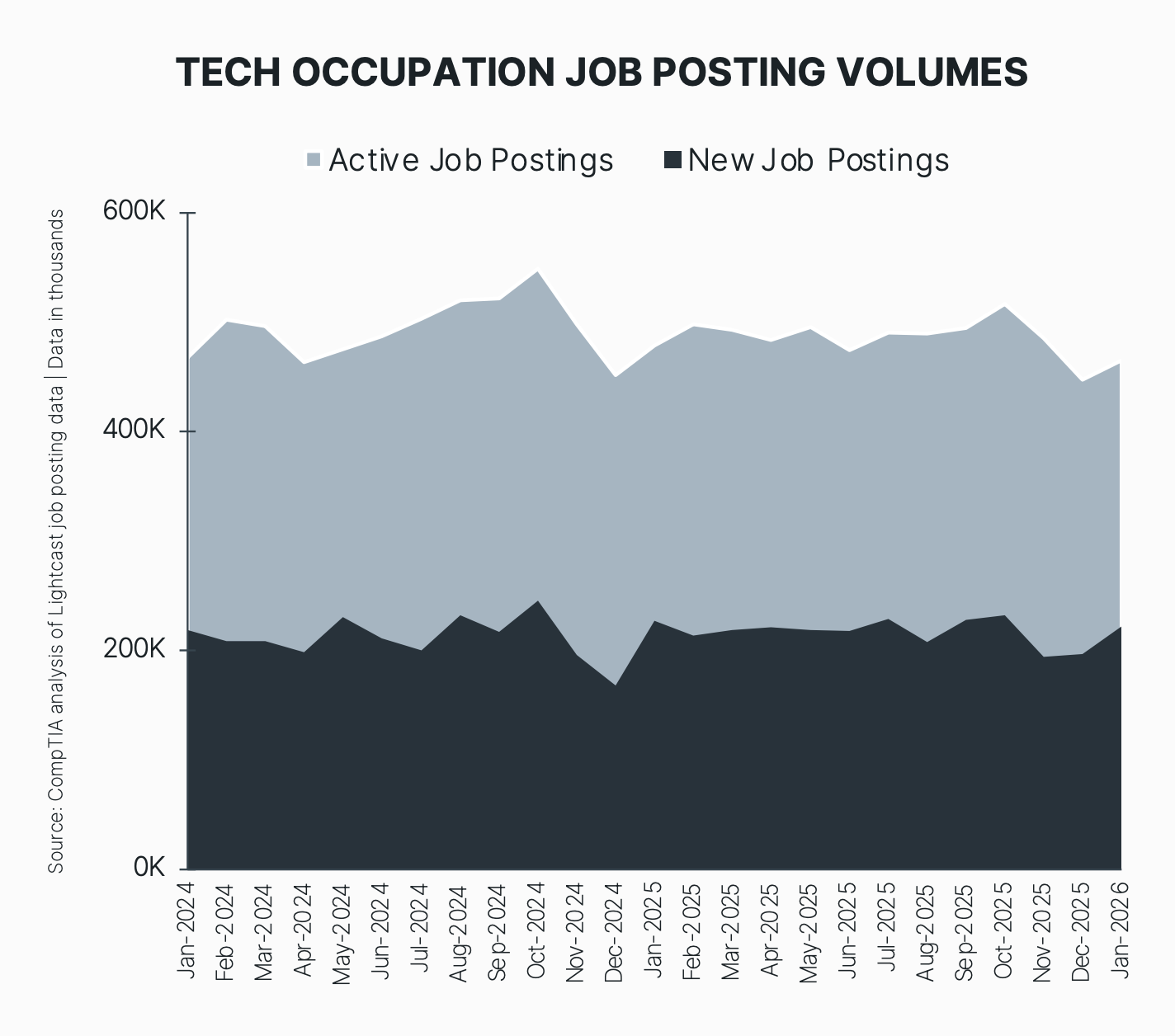
Here we can see that the active tech job postings saw a drastic decrease between September 2024 and December 2024 but have been relatively stable as well as the new job postings. Unfortunately we don’t have a graph that shows how this has changed since 2022. We have to take into account though a recent phenomenon called “Ghost Jobs”.
Ghost jobs are basically job postings from companies that never intend to hire anybody for those jobs but put job postings up so that investors and the world believe that they are growing.
My conclusion for this section would be that there is indeed a downward trend in the tech job market. However, it is very difficult to assess the severity of it because of the way statics are gathered.
Is this “apocalypse” disproportionately affect new graduates and junior engineers compared to senior level engineers?
The most telling statistic is the following that was recently released by Forbes
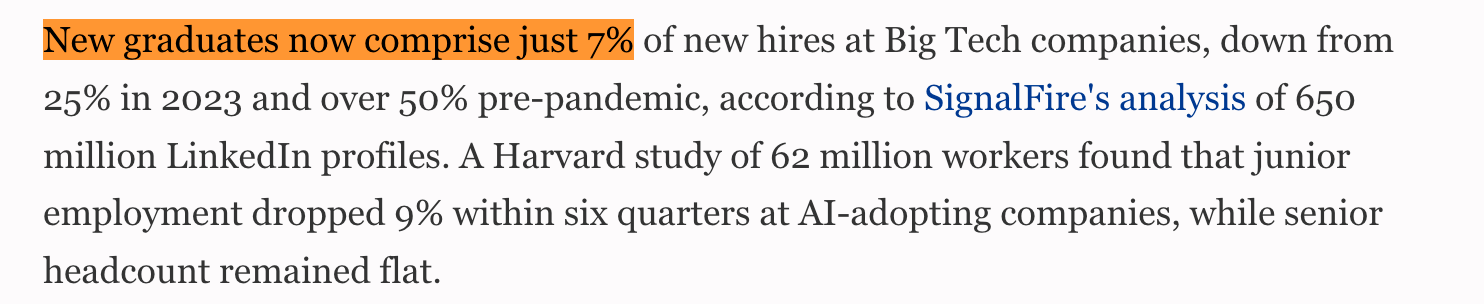
What this tells us is that from all the hirings that happened pre-pandemic, new graduates were 50% of them. But now, we see a different picture, only 7% of new hiring in Big Tech is new graduates. Therefore it safe to assume that this job apocalypse is indeed hitting new graduates and junior engineers the hardest.
This brings us to the big question and the most speculative one:
Why is this happening?
Let me list the most compelling reasons I have read the past couple of years:
Tech companies overhired during the pandemic and therefore the layoffs are a normalization
AI is eventually going to replace software engineering and AI is at this moment (Feb 2026) capable of doing a junior software engineer’s job.
There is general uncertainty about the state of the world which has lead to companies freezing hiring and cost cutting in anticipation of a prolonged recession
High interest rates after ZIRP (Zero Interest Rate Period) have led to a focus on cutting (layoffs) instead of growth
Tax code change which required companies to capitalize and amortize research and experimental (R&E) expenditures instead of deducting them immediately.
My opinion is that the reason is “All of the above”. However, the reality is more complex.
For example, its absurd to think that layoffs in 2026 are happening because of an over hiring that took place in 2022. My belief is that the layoffs that happened the past years showed to companies that they can layoff people and the stock market rewards that, the balance sheet looks better (less expenses → big margins) and the products did not collapse.
Furthermore, the AI race is forcing companies to spend a lot in order to not get left behind (FOMO) and the costs for the AI race have to be covered by laying off other parts of the business. Admittedly, the markets recently did not react in a very positive way when companies announced huge projected Capex for 2026.
In order to justify those huge expenses, companies are promising investors that in 6-12 months all software engineering will be solved, which will lead to huge cost saving for companies and will justify the spending. At the same time they are in a brutal “war” with each other on who will have the best model and win people’s opinions, leading to shortened windows for model releases.
My worry is what will happen to innovation and software quality if AI does not improve in the rate we expect and if it does improve, what will software engineers do?
Even if 2 out of 10 software engineers survive this transition to the AI world, these 2 will be in brutal competition with each other, while the other 8 will look to transition their careers to other domains. However, nobody guarantees that the sector those 8 flee to, will not be the next one in line to be automated.
In each big technological transition, usually people get left behind, either that is the industrial revolution or the internet revolution and no doubt AI has given enormous benefits to the world already and may create the world of abundance that we will love. But the thing with transitions is that they are sometimes painful and don’t happen instantly.
To end in a positive note, I personally hope and want to help in having AGI happen faster, because if the transition is slow the pain of change will be slow too. If AGI happens fast, we can reap the benefits of it faster.